Conceived in Australia. Built for a global future.
THE POD COLLECTS.THE WORLD DECIDES.
A single environment that brings movement, force and human self-correction into one record. Intelligence designed to help people: and the machines learning from them.
Born from our research project with Assoc. Prof. Emel Demircan PhD, the Pod is the expression of a much larger realisation: the protected reflective system can become a complete environment for understanding movement, force and self-correction in real time.
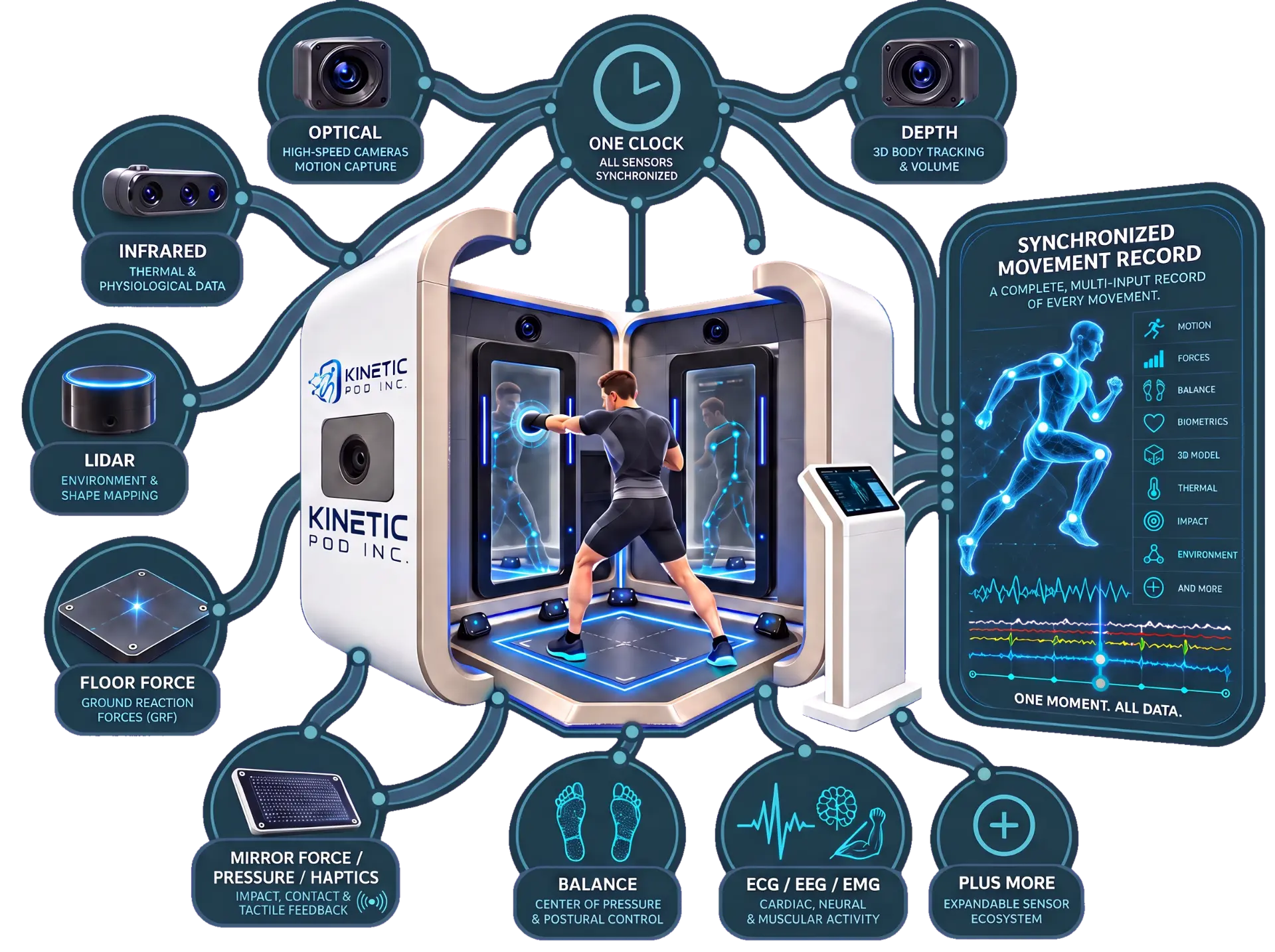
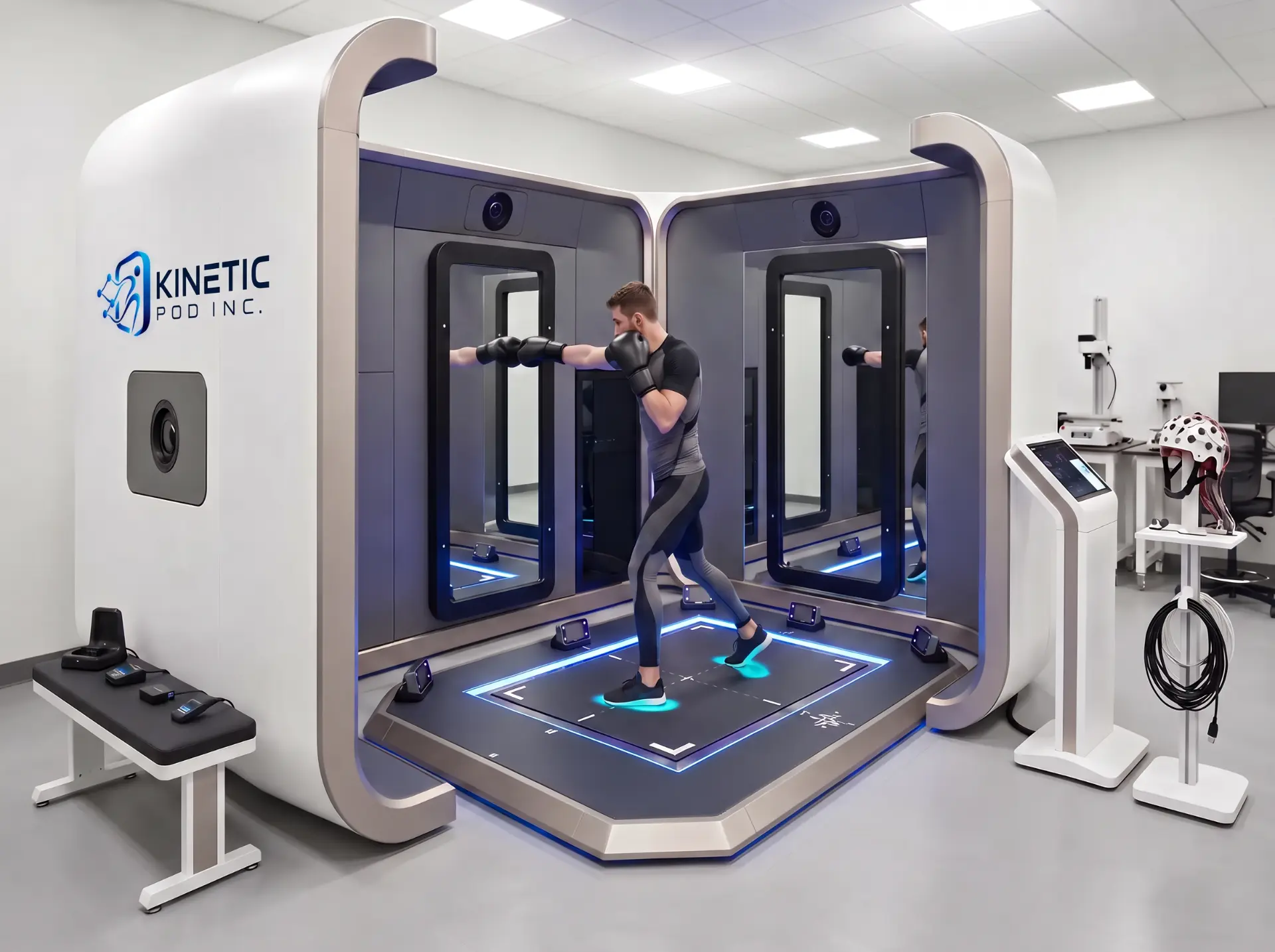
The Kinetic Pod is a walk-in research concept designed to bring a strikeable or pushable reflective surface, an instrumented floor and multiple sensing technologies together around one moving person, on one timeline.
The missing layer
The reflection becomes part of the data
A person sees their movement as they strike or push. The brain responds to that reflection, changes the action and tries again. The Pod is designed to record the movement, the load and the correction together, rather than filming an action after the decision has already happened.
What the Pod collects
01
Movement + depth
Position, joint motion and whole-body trajectories
02
Force + pressure
Impact, ground reaction, load and pressure distribution
03
Balance + timing
Weight transfer, stability, sequencing and recovery
04
Physiology + haptics
Effort, contact and tactile interaction signals
05
The correction
The change between the first movement and the next
All streams are designed to align to the same interaction, creating one synchronized movement record.
02 / Why collect it
Onerecord.Tworesearchpaths.
For people, the aim is to compare movement against the same person's baseline over time. For machines, the aim is to pair motion with the force, contact, balance and correction that video alone leaves behind.
Human movement → synchronized record → machine learning
CONCEPT VISUAL / DATA TRANSFER IS A RESEARCH OBJECTIVE
03 / See the connection
Thesamemovement.Aricherrecordforboth.
↔
HumanRobot
The divider moves automatically. Drag it to compare synchronized human and robot movement.
One movement / two views
04 / POTENTIAL BENEFITS TO
Humans
THE PROBLEM
The end-to-end measurement gap.
Movement is often assessed in separate snapshots. The research gap is one repeatable environment that joins biomechanics, force, pressure, contact, timing, physiology and self-correction in a synchronized record.
04 / POTENTIAL BENEFITS TO
Robots
THE PROBLEM
The 100,000-year data gap.
AI learned from internet-scale text and images, but comparable robot action data is scarce. Video shows what movement looks like, not the force, pressure, timing and correction that produced it.
01
Neurological movement research
Support research into how movement changes over time in areas including Parkinson’s and Alzheimer’s disease, without presenting the Pod as a diagnostic device.
01
Action data beyond video
Pair trajectories with force, pressure, contact, ground reaction and outcomes rather than learning from appearance alone.
02
Rehabilitation and recovery
Compare balance, coordination, compensation and progress against a person’s own baseline through rehabilitation.
02
Balance and force control
Create structured inputs for research into force modulation, stability and recovery from physical disturbance.
03
Performance and safe return
Inform research into exercise performance, readiness, return to work and return to play through repeatable movement records.
03
Adaptation as training data
Capture the change between an initial action and a corrected action as a labeled learning signal.
04
Operational readiness
Explore movement quality, fatigue, balance and recovery for police, military and other physically demanding roles.
04
Human-safe interaction research
Support research into contact-aware control, handoffs and physical human-machine interaction, subject to engineering validation.
What MRI does for the body lying down, the Pod is designed to do for the body standing in motion.
STRUCTURAL IMAGING
MRI scanner
Sees
Anatomy and tissue structure
State
Static. The body lies still.
Moment
A single snapshot in time.
Force
No force, no contact, no load.
Output
A structural image.
MOVEMENT INTELLIGENCE
KINETIC POD INC.
Sees
The body in full motion
State
Dynamic. Under real physical load.
Moment
Continuous, synchronised capture.
Force
Force, pressure, balance, timing.
Output
A living record of movement.
FIG. 14 / MOVEMENT LABORATORY CONCEPT · CONCEPT VISUAL
01
See the movement
Volumetric motion capture, cameras, LiDAR and infrared sensing are intended to reconstruct the body in motion rather than reduce it to a flat video.
02
Measure what it does
An instrumented floor and impact sensing connect movement to force, pressure, balance, timing and recovery on one synchronised clock.
03
Capture the correction
The strikeable reflective surface lets the person see and adjust their movement under real load, making adaptation itself part of the record.
* “Human Movement MRI” is a positioning analogy for the breadth and resolution of the intended movement record. The Pod is not an MRI scanner, medical-imaging system or validated diagnostic device.
High-Fidelity Kinetic Intelligence Synthesis for Contact-Rich Robotics, prepared by Assoc. Prof. Emel Demircan PhD across three phases. Each report is available to download in full.
The strike forces used in the reinforcement learning comparison were synthetically generated rather than measured. The assessment is a simulator and control study.
n=10 (9M/1F), mean age 22.1 ± 4.6 years. Inter-rater reliability Cohen's κ > 0.85.
No improvement in the bag condition between sessions (d = 0.05); moderate improvement with the mirror (d = 0.46). Between-apparatus effect grew from d = 0.58 in session one to d = 1.01 in session two.
n=10 (5M/5F), mean age 24.3 ± 2.7 years. Randomised between-group, 3 hours coach-led training. κ > 0.90.
Mirror group improved 224.2% (d = 6.26) against bag group 194.5% (d = 4.84), with 216.3% transfer to bag-based testing: indicating improved knowledge of performance rather than apparatus-specific adaptation.
The instrument, the six patent families and the capture and ingestion architecture. Not a person's private movement record.
WHAT PARTICIPANTS AND INSTITUTIONS HOLD
Purpose-specific, revocable permissions over their own record, and the decision on how it may be applied.
§ 08 / Origin
An Australian instrument. A global ambition.
Australia has produced research infrastructure that became a world standard before: the cochlear implant, the black-box flight recorder, and Wi-Fi. Each began as Australian research and was adopted globally. The Pod is conceived in Melbourne with the same intent, and with consent and validation built in from the start rather than added afterwards.
§ 09 / The development path
Evidence first. Then the world.
NOW – 2027
Prove the instrument
Complete research builds, test measurement accuracy and establish capture and consent protocols.
2027 – 2029
Found the network
Work towards institutional installations and carefully governed datasets for research and robotics.
2029 – 2032
Expand the standard
Seek broader adoption of validated methods and longitudinal movement records.
Development targets from the project presentation, subject to validation, funding and signed partnerships.
Pod imagery depicts concepts. Proposed capabilities and applications remain subject to technical, clinical and governance validation.